
503 km/h on an Abu Dhabi highway: what BYD's record really measures
The Yangwang U9 Xtreme is the first production car past 500 km/h, in one direction. What the record measures, what it does not, and why it was set in the Gulf.
- Published
- Insights
- 6 min read
The fastest production-car runs, by how they were measured
- Yangwang U9 Xtreme, Abu Dhabi, 2026503.17
- Yangwang U9 Xtreme, Papenburg, 2025496.22
- Bugatti Chiron Super Sport 300+, Ehra-Lessien, 2019490.48
- SSC Tuatara, Florida, 2021455.3
- Koenigsegg Agera RS, Nevada, 2017447.19
- Bugatti Veyron Super Sport, Ehra-Lessien, 2010431.07
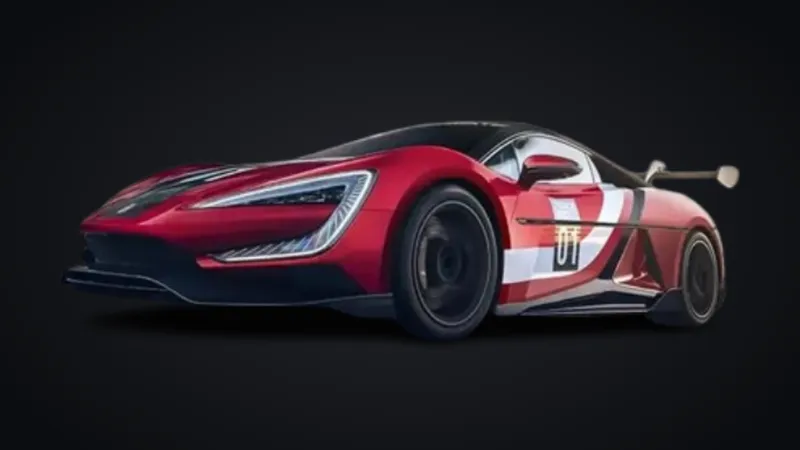
On 1 November, on a 10 km stretch of the Sheikh Khalifa bin Zayed International Road in Abu Dhabi's Al Dhafra region, closed to traffic by agreement with the authorities, the Yangwang U9 Xtreme reached 503.17 km/h. At the wheel was Marc Basseng, the German driver who had already taken the car to 496.22 km/h at the ATP proving ground in Papenburg in September 2025. BYD announced the result today, 6 November, with recognition from the FIA and Guinness World Records.
It is the first time a car sold as a production car has passed 500 km/h. It is also the first time the fastest car in the world, by this measure, is electric and Chinese. Both statements are true. Neither is the most useful thing to know about the record.
How it went
Four runs over two days. On 31 October the first two stopped at around 490 km/h. Overnight the engineers changed the rear wing, the damping and the tyre pressures. On the second day the car used about 7 of the 10 closed kilometres, and the run timed with Racelogic equipment is the one that counts. On that road the normal speed limit is 160 km/h.
The car is the track version of the U9, the electric supercar BYD has sold in China since February 2024: four motors of 555 kW each, 2,220 kW in total, on a 1,200-volt platform. Thirty will be built. Yangwang has not published an official price; the standard U9 lists at 1.8 million yuan in China.
The asterisk: one direction
Guinness awarded two titles: highest speed by a production car and by an electric production car, both in a single-direction run. The detail is not a technicality. The traditional speed record is the average of two runs in opposite directions, so that wind and gradient cancel out. By that standard the best result on record is still the 455.3 km/h of the SSC Tuatara, set in January 2021, ahead of the 447.19 km/h of the Koenigsegg Agera RS in 2017.
The figure below puts the two measures side by side. Above 490 km/h there are only one-way runs: Bugatti with the Chiron Super Sport 300+ in 2019, and Yangwang twice. Bugatti's own precedent is instructive: in 2019 its 490.48 km/h was set with a pre-production car, in one direction, and the production version was then sold limited to 440 km/h. Wikipedia's list of records, which had excluded the 2025 Yangwang run for exactly this reason, has already added the 2026 one. The definitions are moving with the record.
A second asterisk concerns the word "production". The thirty U9 Xtremes are allocated to customers invited to buy them, and the car is approved in China. A production car in the sense of the record, then, but not one a European dealer can order.
What the record actually measures
The car is not the interesting part. The components are. A hypercar record used to be the showcase of a European supply chain: engines, gearboxes, tyres, aerodynamics, all within a few hundred kilometres of Stuttgart, Molsheim or Ängelholm. Here almost everything is BYD's own or Chinese.
- Motors spinning at up to 30,000 rpm. In March 2025 BYD presented its Super e-Platform for the Han L and Tang L, mass-market saloons and SUVs, with motors above 30,000 rpm. The record runs on the same family of technology the group sells by the hundred thousand.
- The battery is a Blade, lithium iron phosphate, the low-cost chemistry of mass-market cars, here rated for a 30C discharge. Running a hypercar at 500 km/h on the chemistry of a city car is a message to every supplier selling nickel as the premium option.
- The tyres are GitiSport e-GTR2 Pro semi-slicks, rated for 530 km/h and described in China as the first Chinese-developed semi-slick built for over 500 km/h. Bugatti's records, by comparison, were run on tyres from Michelin, a European specialist.
Put another way: in Abu Dhabi BYD did not prove it can build one very fast car. It proved that its supply chain, from the cell to the tyre, now reaches where only a handful of European specialists used to.
Why Abu Dhabi, and why now
The road was not chosen at random. In November 2025 Stella Li, BYD's executive vice president, said Yangwang would launch first in the Middle East, in early 2026, then in Europe, then in the Americas. In July 2025 she had told Autocar that the U9, U8 and U7 were all planned for Europe. A record set on a Gulf highway, with the local authorities closing the road, is a launch campaign in the first market and a trailer for the second.
In Europe, as of today, we have found no official price list for Yangwang. BYD pays a 17% countervailing duty on cars imported from China into the EU, which Li herself said would push prices up. The U9 sold 88 units in China in 2024 and 104 in 2025. Volume is not what this car is for.
What to do with this
If you sell luxury or sports cars in Europe, the Xtreme is not a competitor: thirty cars, none for your market. The point is the brand behind it. Yangwang will arrive in Europe with a story already written, the fastest production car in the world, and with an SUV and a saloon to sell. When a Chinese brand starts from the top of the range rather than the bottom, the first customers it takes are the ones who buy on image.
If you work for a supplier, the record is a reference you will hear in negotiations. Motors at 30,000 rpm, LFP at high discharge rates and tyres for 500 km/h are now capabilities a Chinese group has shown in public, with FIA timing. Whoever sells those components in Europe is no longer selling a capability Chinese buyers lack.
If you are assessing an investment in performance or luxury, read the record for what it is: a marketing investment with a known return, measured in attention and in the price of the brand, not in units. The thirty Xtremes will not move BYD's accounts. The way Yangwang is priced in Europe will tell us whether the record worked.
Sources: InsideEVs, 6 November 2026, and The National, 6 November 2026, for the runs, the road, the Racelogic timing, the Guinness titles and the statements of Stella Li, Marc Basseng and the FIA; CnEVPost, 6 November 2026, for the powertrain, the battery and the tyres; Wikipedia, "Production car speed record" and "Yangwang U9", consulted on 6 November 2026, for the earlier records, the 2025 exclusion and Chinese sales; CnEVPost, 5 November 2025, on the Middle East launch plan; CarNewsChina, 22 July 2025, on Stella Li's interview with Autocar; Commission Implementing Regulation (EU) 2024/2754 for the duty on BYD. Speeds and specifications are the manufacturer's as recognised by Guinness and the FIA; the reading of the record is ours.
Keep reading
Italy's largest car dealer groups, 2026: six have said what they turn over
Autotorino, Eurocar, Intergea, Bossoni, Pasquarelli, Giacomel: 2025 revenue as declared, with source and perimeter. Five of the six are buyers.
A dealership has three prices, and one depends on the manufacturer
Property, net assets and goodwill are valued in different ways. A multiple only applies to goodwill, and goodwill depends on the manufacturer's franchise.
Start a conversation
Tell us what you have to decide
The useful first email is short and specific. A deadline helps more than a brief. Write before you are ready: the later we arrive, the fewer terms are still yours to set.
We reply to every email, as quickly as we can.
- 01The decision in front of you, in one sentence
- 02The date it has to be made by
- 03What you have already looked at