
A week after the jump: when the Tesla Roadster will really reach the road
The reveal showed what the Roadster does. The week after showed when it arrives: contract, regulators, engineers, earnings. Europe still has no date.
- Published
- Insights
- 8 min read
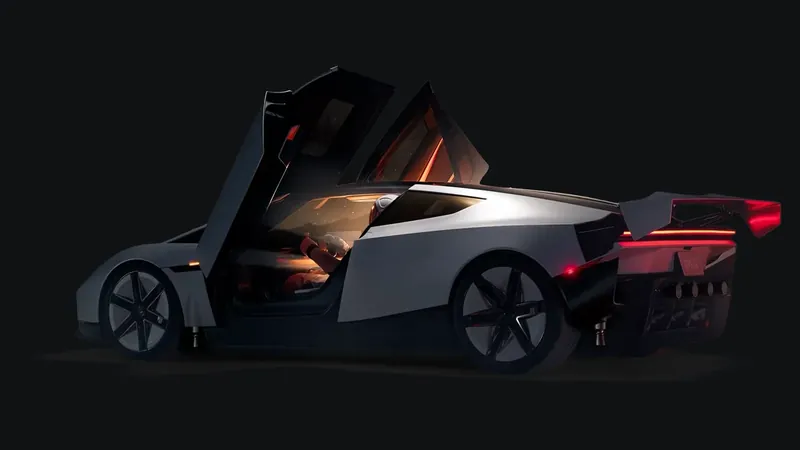
When the Roadster reaches the road
On the evening of 15 October, at SpaceX's test site in McGregor, Texas, the Tesla Roadster did what the evening had been built for: it climbed an inverted ramp, spun in the air and jumped five Teslas in a row on its nitrogen thrusters. The spec sheets, the three versions and the reservations were all over the news the next day.
What interests us is the question the evening could not settle: when will we see it on the road? Answering it meant waiting. In the following week the contract, the American regulators, Tesla's engineers and the quarterly results all spoke, and each pushed the answer a little further out. The result is this: in the United States perhaps in 2028, if the date holds; in Europe there is no date, and the version that jumps may never arrive there in approved form.
The contract: from delivery to order
The most telling document to surface after the reveal is the reservation agreement, read line by line by The Auto Wire on 20 October. The 2017 version said a reservation secured the approximate priority "for taking delivery". The version dated 15 October 2026 says the approximate priority "for configuring and ordering". It adds that the price is only an estimate, that the car is still under development and that Tesla cannot guarantee when it will be delivered, or whether it will be. Deposits, 50,000 dollars for the Performance and 250,000 for the Thrust, are not held separately or in escrow.
This is not boilerplate. Nine years ago Tesla was selling a place in the queue for a car. Today it sells a place in the queue for an order, and those who reserved a three-motor 2+2 in 2017 now face a different two-seater, with Tesla yet to say how it will treat their deposit.
The regulators: nobody owns it
In the days after the reveal the American press asked the federal agencies who should approve a car that leaves the ground. The FAA, the aviation authority, replied that the vehicle does not meet its definition of an aircraft, so it does not have to certify it. The Department of Transportation replied that NHTSA, the road safety agency, "will continue to monitor the situation".
Put plainly: in the United States nobody approves a car before it goes on sale. The manufacturer self-certifies compliance with federal standards, and the agency steps in afterwards with investigations and recalls. The standards do not prohibit thrusters because nobody wrote them with such a car in mind. Use on the road is a matter for each state's traffic law. That is why in the United States the Performance can arrive on an industrial timetable, and why Tesla's own page states the Rocket is not approved for public road use.
The engineers: four or five prototypes
The interviews given by Lars Moravy, vice president of vehicle engineering, and design chief Franz von Holzhausen to Hagerty, Top Gear and MotorTrend are the week's most useful source, because they say where the project stands.
There are four or five prototypes, with a larger build planned for early next year. The base version, below the Performance, is still in development. The Thrust's tank holds 200 litres of nitrogen at around 10,000 psi, roughly 690 bar, and refills in two to six hours from an external high-pressure supply: the target is under half an hour. The numbers are moving too: at the reveal the top speed was "over 230 mph"; the engineers gave Top Gear 214 "for now".
Fifteen months before the announced production year, a car with four or five examples, an entry version still to finish and a tank that today fills from workshop equipment is still a project, not a product.
The results: the Semi is the right yardstick
On 21 October Tesla reported its third-quarter results. Elon Musk mentioned the Roadster demonstration without adding a price or a date. The news that mattered for the Roadster's calendar was a different one: "We also began production of the Tesla Semi truck in Q3", at the new plant in Reno.
The Semi was revealed on the same evening as the first new Roadster, 16 November 2017, with production promised for 2019. It arrived in 2026. That is the most honest yardstick we have: from the same stage, on the same evening, the product Tesla considered more urgent took almost nine years. The Roadster, promised that evening for 2020, has meanwhile moved its production date at least seven times, and 2028 is the eighth. The market caught on quickly: the shares gained 5% before the open on 16 October and gave it back in the days after, and analysts from Dan Ives to JPMorgan wrote that the Roadster will move neither volumes nor revenue.
In Europe the test comes first
Everything learned this week concerns the United States. On Europe Tesla has said nothing: no European configuration, no euro price, no approval route. And this is where the calendar stretches most, because in Europe the system is reversed: a car cannot be registered unless an authority has approved its type, regulation by regulation, before sale. For the Roadster three rules are awkward.
Steering. A yoke and no mechanical column: everything runs through wires and actuators. The European steering rule, UN R79, was written around a column, and amendments for steer-by-wire have been discussed at the Geneva working party between 2024 and 2026. It is one of the reasons the Cybertruck has never been sold in Europe.
Pedestrians. European rules measure what happens to a pedestrian struck by the front of a car, and since July 2024 every new car must carry the mandatory safety package, from automatic emergency braking to an event data recorder. The Roadster is a sharp-edged wedge. The Cybertruck was turned down in Germany over "considerable passive safety concerns".
Tanks. 690 bar is the pressure of hydrogen tanks, for which Europe has a dedicated rule (UN R134). For a tank designed to be emptied through a nozzle while the car is moving it has none. A route exists: Article 39 of the EU type-approval regulation allows approval of a technology the rules do not foresee, if the manufacturer shows at least equivalent protection. But it is an exceptional procedure, and there is no record of it being used for a car that jumps.
The shorter route is small series: up to 1,500 cars a year per type with lighter requirements, 250 for national approvals. For a sports car costing hundreds of thousands, that is enough. But it still takes a European version, and none has been announced.
So, when?
With what we know today, rather than on the evening of the 15th, our estimate is this.
- United States, Performance: no earlier than 2028. With four or five prototypes in October 2026 and the Semi as precedent, it is worth waiting for the first delivered car before counting on it.
- Europe, Performance: no earlier than 2029. Tesla usually brings a model to Europe after launching it in America, and here there is a steering system and a front end to get through.
- Europe, Thrust: perhaps never with working thrusters on the road. A European version without thrusters is more likely, or a Thrust sold as a track car.
- Rocket: never on the road, in any country. Tesla says so.
It is the same distance between concept and price list we measured at the Paris Motor Show, only longer. There, only one Stellantis car had a price, a date and a plant. Here the plant exists, the date is a year, the price is missing, and for Europe the question European manufacturers ask before switching the lights on is missing too: under which rule do we approve it.
What to do with this
If you sell sports or luxury cars in Europe, the Roadster is not a competitor for the next three years. It is a competitor for attention, and the evening of the 15th won that. The cars taking your customers are the ones that already have an approval certificate.
If you work for a supplier, the interesting part is the components: high-pressure carbon-fibre tanks, column-less steering, downforce fans, active aerodynamics. These are technologies European rules are learning to handle, and whoever knows how to get them approved will have work even if the Roadster never arrives.
If you are assessing a deal that depends on a product launch, the Roadster contract is the lesson of the week. The date announced on stage was 2028. The date written in the contract does not exist. A plan is built on the second.
Sources: The Auto Wire, 20 October 2026, for the text of the 2017 and 2026 reservation agreements; Fortune, 17 October 2026, for the replies of the FAA and the Department of Transportation, the deposits and Elon Musk's statement on safety; TeslaNorth, 16 October 2026, on Lars Moravy's interview with Hagerty (prototypes, base version, tanks, fans); Wikipedia, "Tesla Roadster (second generation)", and Motor1 on the Top Gear interviews (refill times, top speed) and on the history of announced dates; Tesla, third-quarter 2026 results call, transcript published by The Motley Fool on 22 October 2026; Invezz, 16 October 2026, and Yahoo Finance on the share price and analyst reaction; TechCrunch and Jalopnik, 15 October 2026, for the reveal; Torque News for the road-use disclaimer; Regulation (EU) 2018/858, Article 39 and Annex V; UNECE, GRVA working documents on UN R79; Automotive News Europe and Notebookcheck on the Cybertruck in Europe. Specifications are Tesla's claims and have not been independently verified. The European dates are our estimate.
Keep reading
Italy's largest car dealer groups, 2026: six have said what they turn over
Autotorino, Eurocar, Intergea, Bossoni, Pasquarelli, Giacomel: 2025 revenue as declared, with source and perimeter. Five of the six are buyers.
A dealership has three prices, and one depends on the manufacturer
Property, net assets and goodwill are valued in different ways. A multiple only applies to goodwill, and goodwill depends on the manufacturer's franchise.
Start a conversation
Tell us what you have to decide
The useful first email is short and specific. A deadline helps more than a brief. Write before you are ready: the later we arrive, the fewer terms are still yours to set.
We reply to every email, as quickly as we can.
- 01The decision in front of you, in one sentence
- 02The date it has to be made by
- 03What you have already looked at